Modern French silver hallmarks are considered among the most reliable authenticity systems in the world. Introduced in 1838, the modern French hallmarking system is government-regulated and helps buyers, collectors, and jewelers verify whether an item is genuine solid silver, determine its purity, and identify its manufacturer.
If you’re buying antique French silver, inherited jewelry, or luxury flatware, learning how to identify these hallmarks can help you distinguish authentic silver from silver-plated items and avoid costly mistakes.
What Are Modern French Silver Hallmarks?
Modern French silver hallmarks are official stamps applied to solid silver items that have been tested and approved by the French assay office. These marks provide essential information, including:
- Silver purity
- Official government assay approval
- Manufacturer or silversmith
- Whether the item is imported or made in France
Unlike many countries that simply use numeric purity marks like 925, France relies primarily on symbolic hallmarks that have been used for nearly two centuries.
1. Identify the Minerva Purity Hallmark
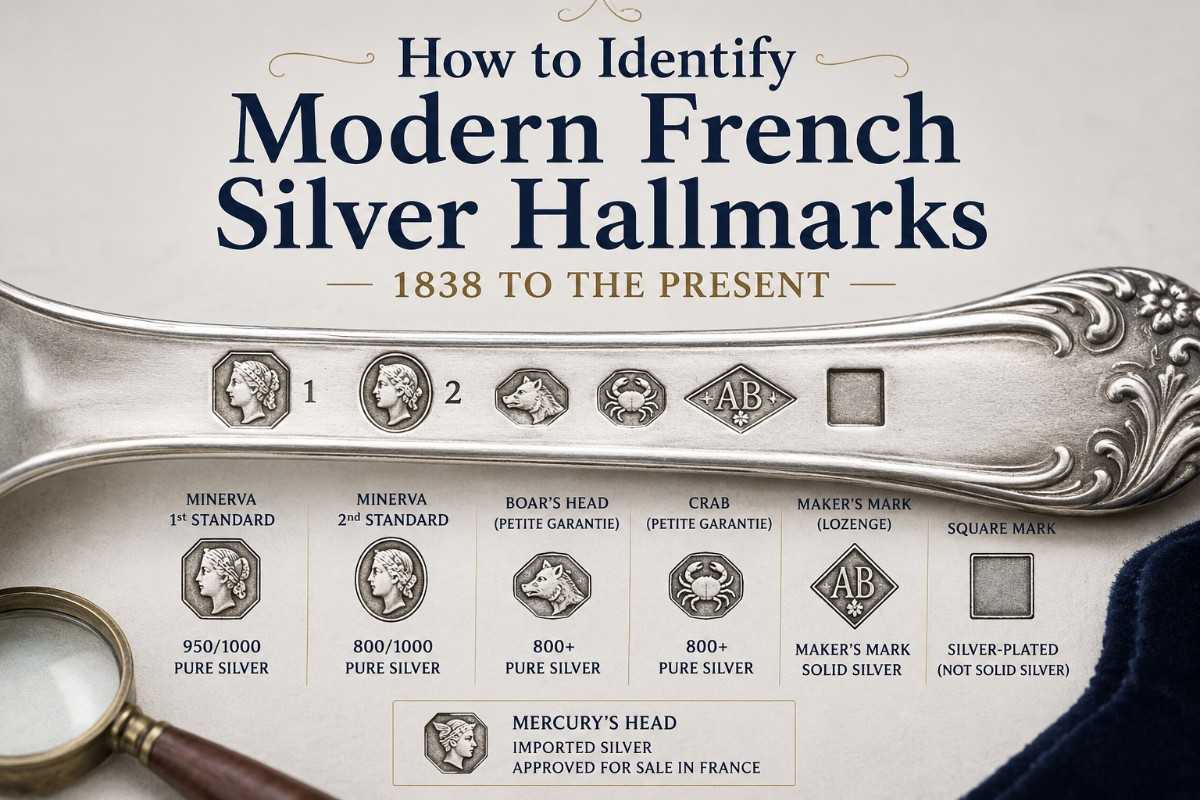
The easiest way to identify modern French silver is by locating the Minerva head, the official French assay mark introduced in 1838.
The hallmark features the profile of the Roman goddess Minerva, symbolizing wisdom and craftsmanship. The shape surrounding Minerva determines the silver purity.
Minerva in an Octagonal Frame (1st Standard)
If Minerva appears inside an octagonal frame, the silver contains:
- 950/1000 (95%) pure silver
- Higher purity than standard sterling silver (925)
- Common on luxury French jewelry, tableware, and decorative objects
This is known as the 1st Standard hallmark.
Minerva in an Oval or Rounded Frame (2nd Standard)
If the Minerva head appears inside an oval or rounded frame, it indicates:
- 800/1000 (80%) pure silver
- Durable alloy commonly used for larger household silver items
This is known as the 2nd Standard hallmark.
2. Look for the Small Guarantee Marks
Some silver items are simply too small to accommodate the detailed Minerva hallmark without affecting their design.
For these pieces, the French assay office uses Small Guarantee Marks (Petite Garantie) instead.
Boar’s Head
The Boar’s Head hallmark indicates:
- Solid silver
- Minimum 800/1000 purity
- Frequently found on:
- Rings
- Earrings
- Small spoons
- Delicate jewelry
Crab Hallmark
The Crab mark serves the same purpose.
Historically:
- Used primarily for provincial or regional French silver
Since 1962:
- Became the standard small guarantee mark used throughout France.
3. Check the Maker’s Mark (Poinçon de Maître)
One of the most important hallmarks on any French silver item is the maker’s mark, officially known as the Poinçon de Maître.
Unlike purity marks, this identifies the workshop or silversmith responsible for manufacturing the piece.
Diamond (Lozenge) Shape = Solid Silver
A genuine French maker’s mark appears inside a diamond (lozenge-shaped) frame.
It usually contains:
- The maker’s initials
- A unique workshop symbol
- Sometimes a small emblem identifying the silversmith
Every registered French silversmith has a unique maker’s mark, making it one of the best ways to authenticate an item.
Square or Rectangular Mark = Silver-Plated
If the maker’s mark appears inside a:
- Square
- Rectangle
the item is silver-plated, not solid silver.
This distinction is one of the quickest ways to avoid confusing plated items with genuine French silver.
4. Identify Imported French Silver
Not every silver item sold in France was manufactured there.
Imported silver is commonly marked with the Mercury’s Head hallmark.
This mark features the profile of Mercury wearing his distinctive winged helmet and indicates that:
- The item was made outside France
- It passed French assay inspection
- It is legally approved for sale in France
This hallmark does not identify purity by itself, so it should be examined alongside other marks.
Where Are French Silver Hallmarks Located?
The location of hallmarks varies depending on the type of silver item.
| Silver Item | Typical Hallmark Location |
|---|---|
| Spoons & Forks | Back of the handle or neck |
| Bowls & Hollowware | Bottom or near the rim |
| Rings | Inner band |
| Bracelets | Clasp or inside link |
| Necklaces | Clasp or tag |
| Decorative Objects | Base or underside |
Always inspect every surface carefully because multiple hallmarks are often present.
How to Inspect Modern French Silver Hallmarks
Because French hallmarks are intentionally tiny and highly detailed, proper inspection is essential.
Use a 10× Jeweler’s Loupe
A 10× magnifying loupe is one of the best tools for reading French silver hallmarks.
It helps reveal:
- Minerva’s facial profile
- Border shape
- Tiny maker’s initials
- Workshop symbols
Examine Under Angled Lighting
Instead of shining light directly onto the hallmark, hold the item under angled lighting.
The shadows created by the recessed stamp make fine details much easier to see.
Clean the Area First
If the hallmark is covered by dirt or tarnish, gently clean the surface with a soft polishing cloth before inspection.
Avoid aggressive polishing, especially on antique silver.
Common Modern French Silver Hallmarks at a Glance
| Hallmark | Meaning |
|---|---|
| Minerva in Octagonal Frame | 950/1000 pure silver (1st Standard) |
| Minerva in Oval Frame | 800/1000 pure silver (2nd Standard) |
| Boar’s Head | Small guarantee mark for 800+ silver |
| Crab | Small guarantee mark, standard nationwide after 1962 |
| Diamond (Lozenge) Maker’s Mark | Registered maker of solid silver |
| Square or Rectangle Maker’s Mark | Silver-plated item |
| Mercury’s Head | Imported silver approved for sale in France |
Resources for Identifying French Maker’s Marks
If you want to identify the exact silversmith or verify a maker’s hallmark, these references are widely used by collectors and experts:
- Silvercollection.it – Comprehensive directory of French silversmiths and registered maker’s marks.
- 925-1000 Illustrated French Hallmarks Guide – Visual reference for French purity hallmarks, maker’s marks, and historical symbols.
- Online Encyclopedia of Silver Marks – Detailed information on French silver hallmarks, dates, manufacturers, and historical specialties.
These resources are especially useful when researching antique or collectible French silver.
Final Thoughts
Learning how to identify modern French silver hallmarks becomes much easier once you understand the key symbols used by the French assay system. Start by locating the Minerva hallmark to determine purity, then check for the diamond-shaped maker’s mark to confirm the manufacturer. For smaller items, look for the Boar’s Head or Crab guarantee marks, and remember that Mercury’s Head identifies imported silver approved for sale in France.
By combining these hallmarks with careful inspection using a magnifying loupe and proper lighting, you can confidently distinguish authentic French silver from silver-plated pieces and make informed purchasing decisions.
Frequently Asked Questions About Modern French Silver Hallmarks
Whether you’re buying antique silver, inherited jewelry, or collectible tableware, understanding modern French silver hallmarks helps you verify authenticity, determine purity, and avoid silver-plated imitations. Below are answers to some of the most commonly asked questions about French silver hallmarks.
How can you identify modern French silver hallmarks?
You can identify modern French silver hallmarks by looking for the Minerva head, which indicates the item’s purity, and the diamond-shaped (lozenge) maker’s mark, which identifies the registered silversmith. Small items may instead feature a Boar’s Head or Crab guarantee mark.
What does the Minerva hallmark mean on French silver?
The Minerva hallmark is the official French assay mark introduced in 1838. It certifies that the item is genuine solid silver and has been tested by the French assay office. The shape surrounding Minerva determines whether the silver is 950 or 800 purity.
What is the difference between the Minerva 1 and Minerva 2 hallmarks?
Minerva 1 (octagonal frame) indicates 950/1000 pure silver, while Minerva 2 (oval or rounded frame) represents 800/1000 pure silver. Both are official French purity standards, but 950 silver has a higher silver content.
What does the diamond-shaped maker’s mark mean?
A diamond-shaped (lozenge) maker’s mark, known as the Poinçon de Maître, identifies the registered French silversmith or manufacturer. It typically contains the maker’s initials and a unique workshop symbol, confirming that the piece is made of solid silver.
Does a square or rectangular mark mean solid silver?
No. A square or rectangular maker’s mark generally indicates that the item is silver-plated, not solid silver. Genuine French solid silver uses a diamond-shaped maker’s mark.
What is the Boar’s Head hallmark on French silver?
The Boar’s Head is a small guarantee mark used on tiny silver objects, such as jewelry or small flatware. It certifies that the item meets the French silver purity standard of 800/1000 or higher.
What does the Crab hallmark mean on French silver?
The Crab hallmark is another small guarantee mark used on small silver items. It originally appeared on regional French silver and became the standard nationwide mark after 1962.
What does the Mercury’s Head hallmark indicate?
The Mercury’s Head hallmark identifies imported silver that has been officially assayed and approved for sale in France. It shows that the item was manufactured outside France but complies with French regulations.
Where are French silver hallmarks usually located?
French silver hallmarks are typically found on the back of flatware handles, the bottom of hollowware, the inside of ring bands, or the clasp of necklaces and bracelets. Their exact location depends on the type of silver item.
What tools are best for reading French silver hallmarks?
A 10× jeweler’s loupe is the best tool for examining French silver hallmarks. Using angled lighting can also help reveal the tiny details of the Minerva head, maker’s initials, and other official symbols.
Are French silver hallmarks more reliable than numeric purity stamps?
Yes. French silver hallmarks are widely regarded as one of the world’s most reliable hallmarking systems because they are government-regulated and include both an official assay mark and a registered maker’s mark, making authentication more secure than relying solely on numeric purity stamps.